By Ashley Anderson
One of the many ways science benefits children is that it helps them communicate more accurately, remain organized, focus on a task at hand and form their own opinions based on observation. Developing scientific thinking is helpful from early childhood, even before the child learns to understand the meaning of the word “science.”
To inspire a child to love science, you don’t need to study popular science literature and encyclopedias with them (although it helps). Science is all around us, just waiting to be explored in everyday things. Read on for some helpful steps to make science easy and fun for your child.
1. Generate Intrigue
Children are naturally curious, which makes it easy to grab their attention and get them interested in scientific topics such as on walks, and through fun Q&A and experimentation. The father of the famous Nobel Prize-winning physicist Richard Feynman used this very approach. Instead of relying on physics textbooks and memorizing formulas to fuel his son’s curiosity, Feynman’s father talked to him about everything around him. And he encouraged him to not just to look, but peer into the essence of things, to research and to analyze.
2. Create the Atmosphere
The next step is to immerse your child in environments in which they can learn from and collaborate with others, apply their knowledge and skills and explore new challenges. There are several ways:
Science Camps
The immersive camp experience gives children the opportunity to hone their intellectual skills and try on different roles: such as a biologist, paleontologist, physicist or chemist. Under the guidance of teachers, they can conduct experiments, solve non-standard problems and work on exciting projects. These camps are usually hosted by universities or museums and combine science and adventure, letting children expand their knowledge in mathematics, medicine, biology, chemistry, physics and other subjects in a hands-on way. Instead of attending lectures, children learn through practical observation, experimentation and fun activities.
Science Festivals
Science festivals create an exciting opportunity for attendees to experience the sciences and connect with experts they might not usually interact with. They allow participants to engage in discussions about more complex topics and take part in hands-on workshops. From art exhibits to experiments that show how concepts like gravity work, there’s something for every young science enthusiast.
Olympiads & Tournaments
These events let children compete with peers from other schools both regionally and nationally. They’re great for building confidence, allowing them to share ideas with other children and developing creativity and thinking skills through challenging tasks and research assignments. Science competitions can provide the best of all worlds for students: motivation, learning new material and reinforcing previously learned information.
Online Resources
Video lectures by scientists and teachers tell children about science in a fun and straightforward way. There are several interactive scientific websites that offer hands-on activities, quizzes on a variety of topics, virtual experiments and other immersive learning activities. Examples include: NASA Kids’ Club, National Geographic Kids and more. Something else that could also prove helpful is checking online for medical content writers that are experts on children & childhood. Such freelancers can offer invaluable advice regarding science and research.
3. Work on Special Projects
Your child can also independently research any scientific topic that interests them with help from you. While they’ll get the most value from the project by doing the leading work on their own, you can help define goals, objectives and a sequence of actions and suggest where to look for more information. You can then help them apply what they learned by creating a presentation, an infographic and even a cartoon. Here’s how:
Step 1. Choose a Topic
At this stage, your participation as a mentor is important. Start by giving your child interesting ideas and inspiring enthusiasm.
Step 2. Determine the Purpose of the Project
Once you’ve landed on a topic to explore, it’s time to formulate the goal—the desired result to work toward. Try to keep it as simple as possible. Starting with an action-oriented word (such as “study,” “find out,” “learn,” “research,” or “verify”) finish with what you want to study. For example: “learn about how volcanic eruptions occur.”
Step 3. Select Research Methods
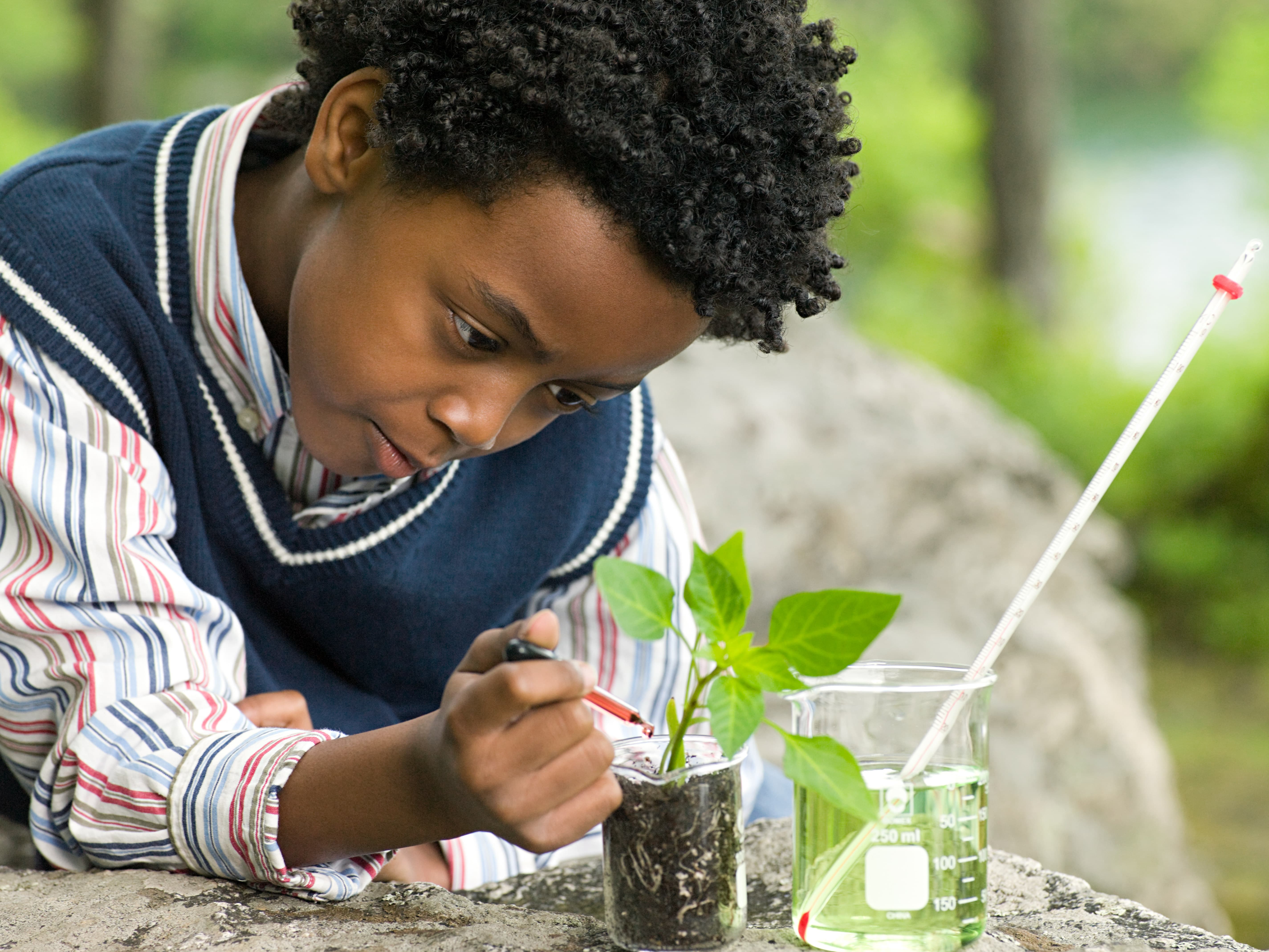
Will you use observation? Ask questions? Counting, measuring or comparing objects and behaviors? A combination of these things? Experiments, models and analyses help children collect facts and check them, arrange them and find patterns.
Step 4. Set Your Tasks
After you have clarified the project’s purpose, next you’ll determine what your child will need to do to achieve their goal. For instance if it is to learn about volcanic eruptions using a model, the first task may be to demonstrate the chemical reaction that creates carbon dioxide by putting vinegar, water, dish soap and two drops of food coloring into the empty soda bottle. The next step would include mixing the baking soda slurry until it is all a liquid. The final step would be pouring the baking soda into the soda bottle and stepping away. And the result would be the eruption or the volcano.
Step 5. Evaluate results
Once you have selected the method of research and completed each task, it’s time to go over what you learned and draw your conclusions.
For added fun, record the experiments as they’re in progress so your child can watch it afterwards. It’ll allow them to see the experiments from a different point of view and share their project work with friends and family.
The bottom line is, you don’t need to have an advanced degree to nurture a love or respect for science in your children. All you need is to use resources from everyday life and take part in events and activities that will give your child exposure to the scientific experience. With these simple steps you can help your child naturally reach for knowledge and learn how to observe, experiment and reason about the world around them.
About the Author

Ashley Anderson is a science teacher. She encourages her students to explore the internet in addition to reading books at school to expand their creativity and knowledge.