
By Jessica Golz, courtesy of teachergolz.com
When I say the word “research” to any of my classes it is almost immediately followed by a collective groan. Instead of groaning along with my classes, I take that giant “ugh” as a challenge. How can I do everything in my power to make research high interest, engaging and meaningful? Meaningful being the keyword there, as there are so many different foundational skills to teach in research as we do our best to create lifelong learners.
Let’s talk authenticity with our research. How do we perform research as functioning (or semi-functioning) adults?
The first thing I do when I have a question … Google. Okay, if we are being honest here, it depends on the question. Sometimes my front line in the inquiry process is YouTube because, let’s be honest, there is a tutorial for everything under the sun out there.
Now, as a college educated millennial, I know there is a proper place for books, videos, virtual reality, face-to-face conversations and all other modalities of finding information when it comes to research. I want to highlight a couple of my “a-ha moments” in regards to how our little ones take part in the inquiry process.
Quick note on research with different grade bands: When the CCSS (Common Core Safety Standards) are broken down, for K-2 they are simply trying to collect facts on a specific topic. The skills build on each other through the grade bands, but simple fact-finding is the main idea of the research process in K-2.
[Research for grades] 3-5 focuses more on conducting short research projects that build knowledge through investigation of different aspects of a topic. Again, this will look different at each grade level, but for this group, that is the main goal.If we were to dive into library standards and technology standards there would be a whole slew of targets to hit, so I will spare you on those.
Let’s go.
Start with a Question
Talk with your students about how scientists and researchers always ask questions. This is how they identify their topics to research. Two of my favorite strategies to encourage questioning are KWHLAQ [Know, Want, How, Learned, Action, Questions] and QFT [Question Formulation Technique]. It wouldn’t be education if we didn’t load up on acronyms now, would it? Everyone is familiar with KWL [Know, Want to Know, Learned], but the reason I love KWHLAQ is we add the citizenship piece to our research and in turn create more meaning for our students as civilians and community contributors.
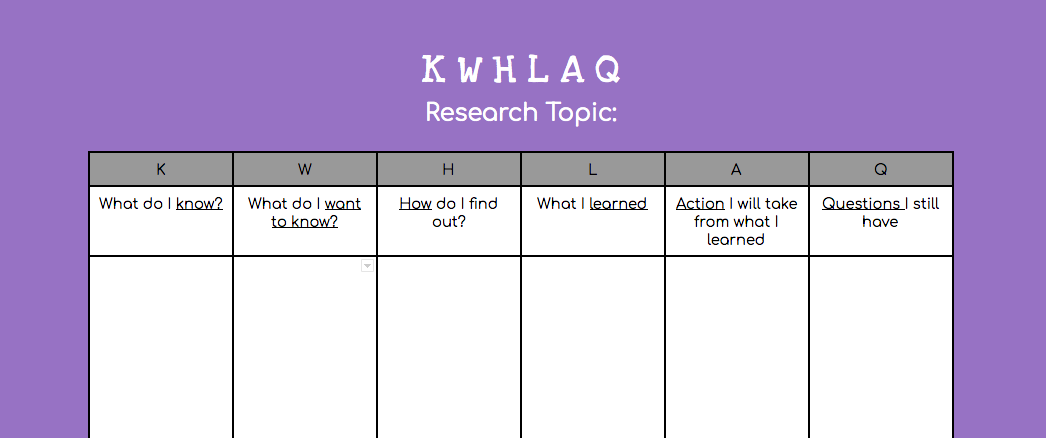
K (what you know) W (what you want to know) H (how will you find it) L (what you learned) A (what action will you take as a result of your research) Q (what questions you still have).
The H is so important to teach how we do research and the addition of that A and Q—oh how we love a reflective moment.
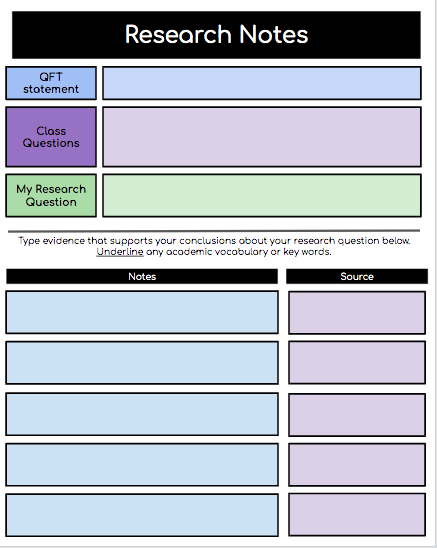
QFT = Question Formulation Technique. From the originators, here is the definition of QFT.“The Question Formulation Technique (QFT) is a simple but rigorous step-by-step process created by the Right Question Institute to help all people—students and adults—formulate, work with and use their own questions.”
I am going to link you to an absolutely fabulous, credible source here so you can take a look for yourself.
… also grab yourself a copy of the QFT note-taking doc I use with my students as a freebie here!
Doing the Work
One of my favorite ways to put credible sources in front of my students is with a Hyperdoc Research Menu. In elementary school, we really want to focus on providing these sources for our students, whereas when they get older we can open up the doors and teach them how to find credible sources themselves. The reason I love a Hyperdoc Research Menu is students can have access at all times to a visually appealing, simple menu, where they can immediately access credible sources that are already linked for them.
Sources
Say hello to serious engagement. This is my favorite part about research with students. As a class, we brainstorm all the different ways we can collect information. This usually becomes a giant list with tons of lightbulb moments. For example, if we want to learn more about animals we could absolutely (and should absolutely) interview a Zoologist—HELLO, SKYPE IN THE CLASSROOM!
Special opportunities like that may pop up, but I have a couple solid ways that my students find information in my physical space—books, websites and AR (Augmented Reality)/VR (Virtual Reality).
On their menu they will simply see LC book which is usually a small collection I will pull for them on their topics. I choose the websites that students are accessing. That brings me to one of my all time favorite resources, Epic!.
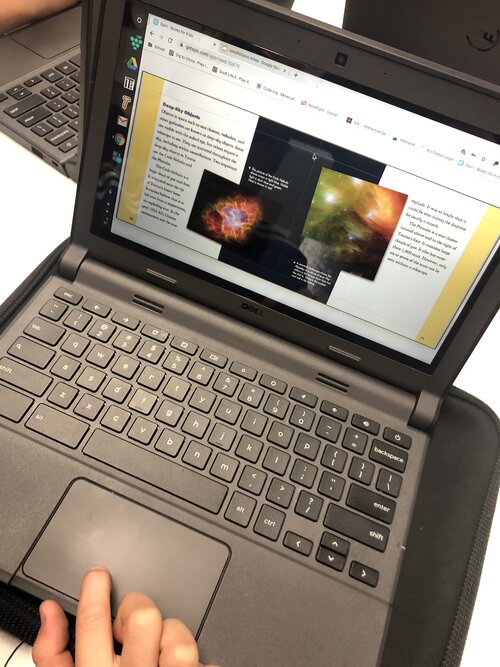
Many teachers and students use Epic! for independent reading, but I have loved harnessing its power for teaching research.
An essential for me when it comes to gathering information is that students are exposed to different types of formatting while collecting information.

Epic! not only provides online texts for students to read, but also has videos where students can work on their information gathering skills in an authentic manner (remember the YouTube tutorials?!).
It is our job to set students up for success in lifelong learning, and websites such as Epic! provide the perfect platform for us to give students opportunities to develop research skills in an authentic manner. You can sign up for Epic! with this link to get a plethora of free high-quality text resources to use with your students in your classroom! Winning.
When it comes to making observations using Virtual Reality, I use Google Expeditions. When we were doing our research on city-planning for our 3D city unitt—we went to Europe on an architectural tour. During our constellation study, I threw my students up into space. Studying penguins? Why not head down to the Antarctic to study them closely, all while teaching students about being mindful about making observations and recording them! We look around and then stop and jot at each location.
There are some AR apps that I just love, too. Merge Cube is a great AR research tool as well as apps like Skyview where you can merge other worlds with ours. Coolio.
Show What You Know
This is where innovation and creation come to play. We will save that for another, and another, and another blog post on all the ways we can creatively show what we know.
Helpful Things!
Your Literacy Standards Companion
About the Author

Be a Spark Contributor!
Do you have innovative ideas or inspiring stories to share with your fellow Epic! Educators? Be a guest author for Spark!
Submit your topics and ideas to spark@getepic.com.
Be sure to check out these guidelines before submitting your post.