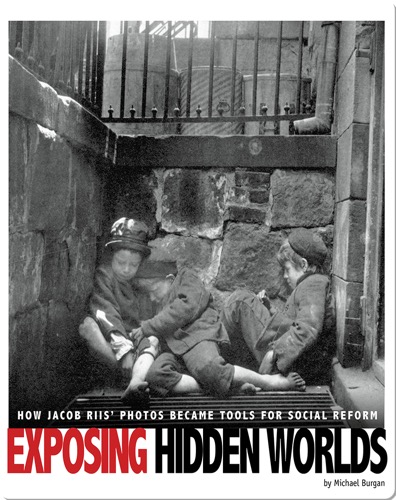
Exposing Hidden Worlds: How Jacob Riis' Photos Became Tools for Social Reform

Exposing Hidden Worlds: How Jacob Riis' Photos Became Tools for Social Reform book cover
Chapter One INTO THE SLUMS Late on a fall night in 1887 journalist Jacob Riis headed out into the slums on the Lower East Side of New York City Riis knew these dark streets and crowded buildings well For 10 years he had roamed the city looking for stories to write for the New York Tribune newspaper He mostly wrote about police news which included reporting on crimes fires and public health and safety Riis wrote that he had covered all the news that means trouble to some one 1 Many of the people Riis saw and wrote about were immigrants From 1881 to 1890 more than 5 million immigrants came to the United States Many were poor and uneducated and they struggled to find decent jobs Large numbers came through the port of New York and then stayed there By 1890 about 40 percent of the city’s population had been born in another country Riis too was an immigrant He was born and raised in Denmark After coming to the United States he had experienced bouts of poverty and knew what it was like to be homeless As a reporter he was determined to show other Americans what life was like in the slums of the country’s largest city Riis hoped that his reporting would lead the public and government officials to work together to improve living conditions for the people who were crowded together in run-down dirty apartment buildings called tenements
Exposing Hidden Worlds: How Jacob Riis' Photos Became Tools for Social Reform

Exposing Hidden Worlds: How Jacob Riis' Photos Became Tools for Social Reform

President Theodore Roosevelt called Jacob Riis "the best American I ever knew." The pioneering photojournalist, an immigrant from Denmark, drew attention to the poverty and evils of slum life in the late 1800s. Riis won national acclaim when his photos illustrated his bestselling book How the Other Half Lives. The book focused on the difficult time immigrants faced as thousands of newcomers flooded into the United States each year. Riis called for reform and hoped to prod government officials to help the poor people who were forced to live under horrible conditions. The impact of Riis' photos came from capturing the poor and homeless as they lived and worked, with the subjects' eyes often staring directly into the camera. The great photographer Ansel Adams called them "magnificent achievements in the field of humanistic photography." But the reforms that came from Riis' work have not eliminated urban poverty and homelessness, and important work remains to be done.

About This Book

By: Michael Burgan
Illustrated by:
Published by: Compass Point an imprint of Capstone
9-12Age Range
7.0 AR
56Pages
EventSubject
1060LLexile
45-60 minsReading Time
ZGuided Reading
ZFountas & Pinnell
80DRA